
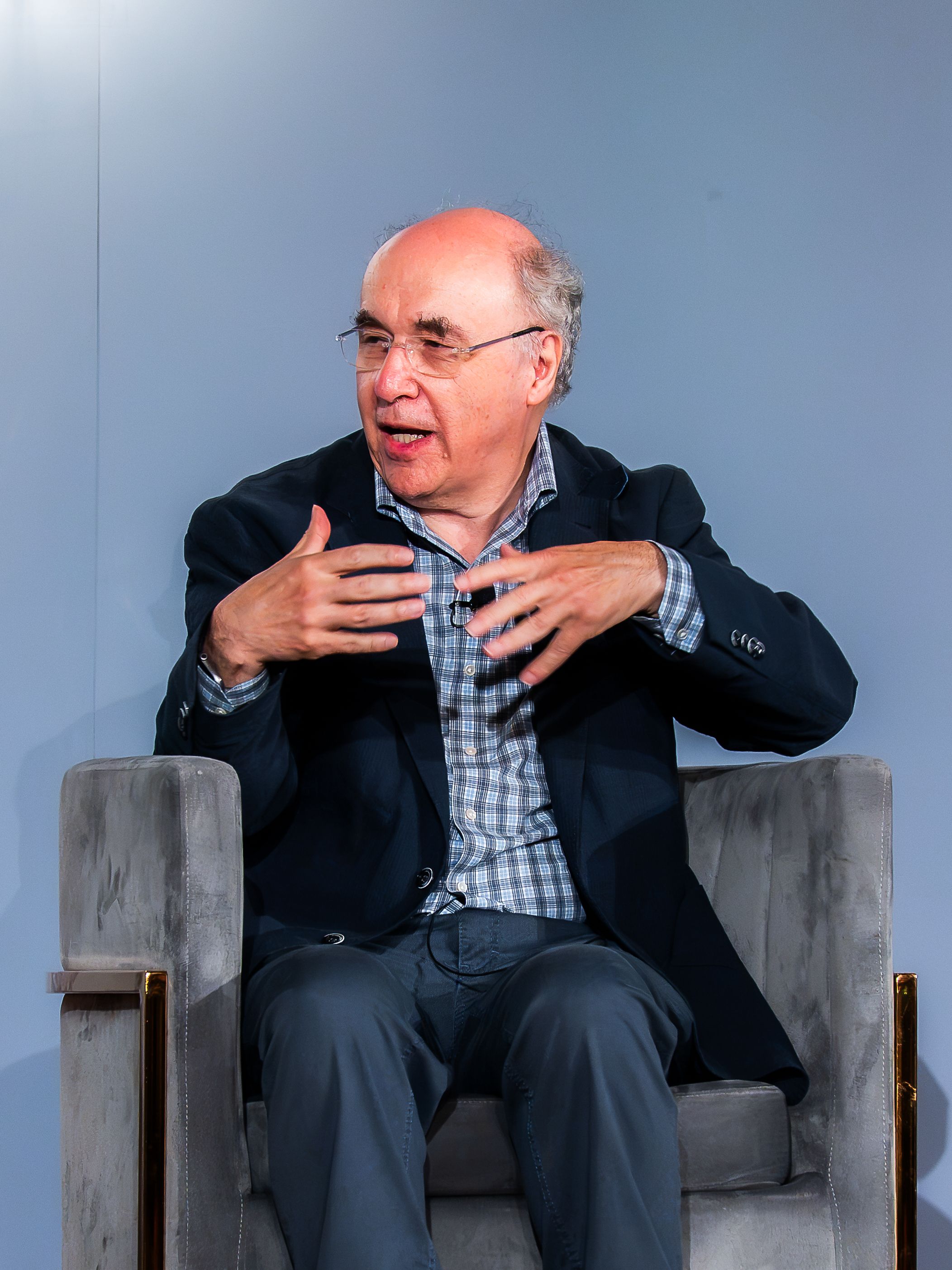
Can AI finally close the gap between natural language and computation? This was the central question Dr. Stephen Wolfram and Scott Worland, CTO at Norm, set out to answer in their session at the Central Park AI Forum. Dr. Wolfram is the CEO of Wolfram Research and the creator of Mathematica, WolframAlpha, and Alpha in the Wolfram Language.
The History of Computation and Law
Dr. Wolfram traced the relationship between humans and computation back to the 1600s. Gottfried Leibniz, co-inventor of calculus, also was a leader in the philosophical language movement, which sought to create a mathematical-style representation of everyday language. He was particularly focused on grounding legal decisions in mathematical processes. Unfortunately he was not successful in his era. Although he identified that contracts have a precise symbolic language, there was no translation layer between that notion and the English language.
Wolfram’s theory is that with the advent of modern AI, we can finally achieve what Leibniz set out to do in the 1600s. He posits that AI is the layer between humans and computation: if AI can convert legalese into symbolic language, we can compute with it and extend reasoning far beyond what humans can do on their own.
He has dedicated his life’s work to making the world computational. His belief is that once there’s a precise computational way to represent complex things such as cities, chemicals, or paths between two items, you can get deeper answers about them. He created WolframAlpha in 2009, when many thought AI was dead. WolframAlpha translates natural language into a precise symbolic language from which we can compute things. It has also since been used in the development of major large language models.
Creating the Knowledge Layer
While AI can serve as the layer between humans and compute, we still require another layer between humans and AI to understand the AI systems underlying reasoning. Consider an example from mathematics: when someone uses AI to solve a theorem, they often can’t describe what the AI actually did. They need an intermediate layer that is both precise and understandable to humans, something Wolfram is now dedicated to creating.
This need is greatest for complex, theoretical problems where judgment is a key component. We need confidence that a system won’t do anything harmful and that we know what will happen a trillion steps down the line. Today, the only way to be sure of an AI systems’ judgment is to run every one of those trillion steps because even when the rules are knowable, the system can surprise you. That leaves a difficult choice: use AI only for simple, easily knowable tasks, or accept that a system doing sophisticated tasks may surprise you.
History Bends Toward Automation
While trusting an unpredictable system seems counterintuitive, Wolfram notes that we’ve done this for centuries. For instance, horses were the best way to get around, yet the animals are highly unpredictable.
He argues that, whatever the drawbacks, history has always bent toward automation. At each turning point, we’ve seen the same anxiety: will automation replace humans? Wolfram’s view is that it does the opposite, and creates opportunities that didn’t exist before. The US’ move towards automation in agriculture positively reshaped the economy and allowed people to move into work that had not existed before.
We should therefore embrace automation, particularly in the legal space, where it can create opportunities we can’t yet imagine and expand human time and ability.
Agent-to-Agent Interaction
Wolfram and Worland closed with a discussion of AI-to-AI interaction. Wolfram noted that while this area is still mysterious to most, agents in fact behave much like humans. The only difference is that they may act more efficiently or weigh a greater breadth of options.
The central question as Agent-to-Agent interaction becomes commonplace is, how to build the right legal systems for this new era. In what language should laws for agents be written? Do agents have freedom of thought like humans? And since we can’t restrict an AI system’s internal thoughts, should we constrain the actuation layer instead?
If we can answer these questions, we can fully harness AI as the layer between humans and computation.